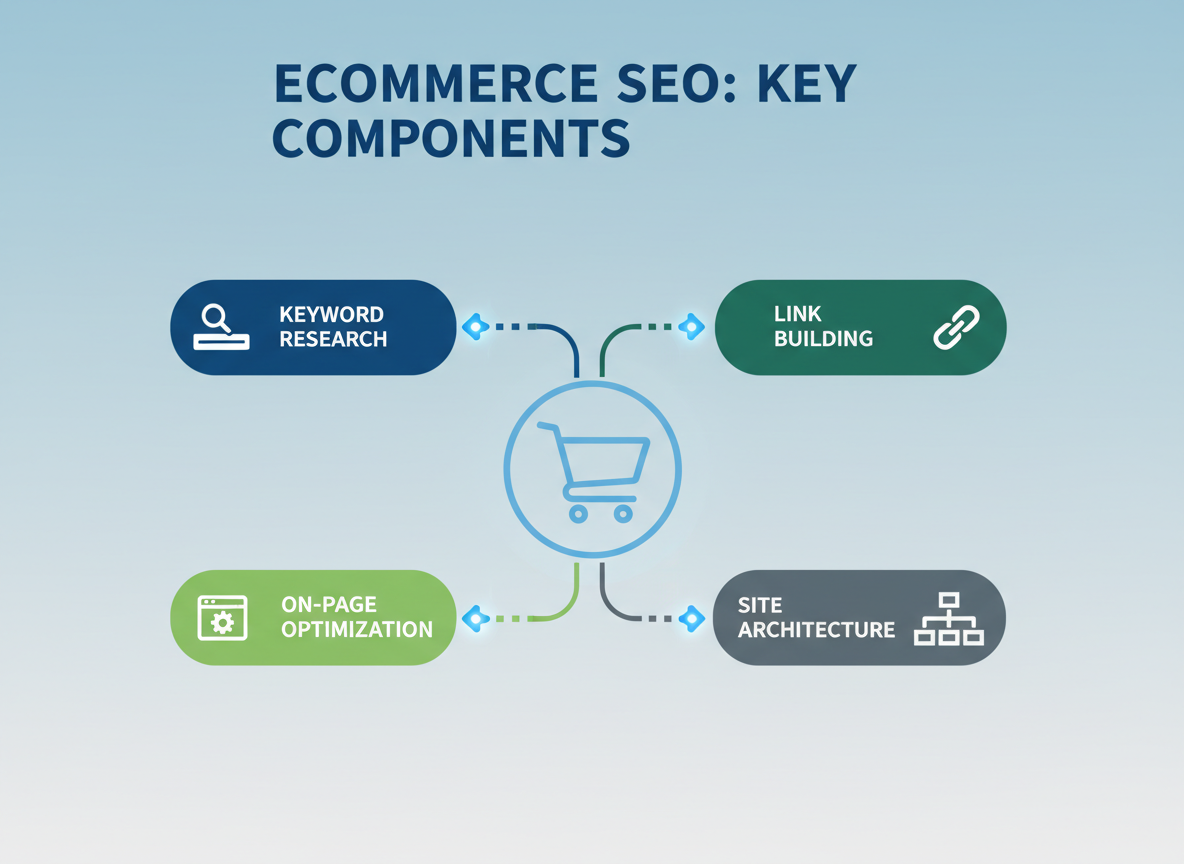
Do you have an Ecommerce business and want to increase organic traffic to your website and achieve more conversions for free? If so, ECommerce SEO is definitely the strategy that will work for you. Want to know more about this? Then read this guide to the end.
Ecommerce SEO is a specialized subset of Search Engine Optimization focused entirely on driving organic, transactional traffic to an online store. It is a meticulous process where you can optimize the product and category pages of any e-commerce website to increase organic conversions. This is achieved by successfully ranking your website category and product pages on the first page of Google, where over 90% of search clicks occur.
How it Works: Search engines operate by crawling, indexing, and ranking content. Successful Ecommerce SEO ensures that when a potential customer searches for a product or category (e.g., “waterproof trail running shoes”), your store’s page is the most relevant and authoritative result. By optimizing page speed, keyword usage, internal linking, and link authority, we signal to Google that your page offers the best user experience and the most accurate information, leading to high-volume, high-intent traffic that converts into sales.
What Is the Process of Ecommerce SEO?
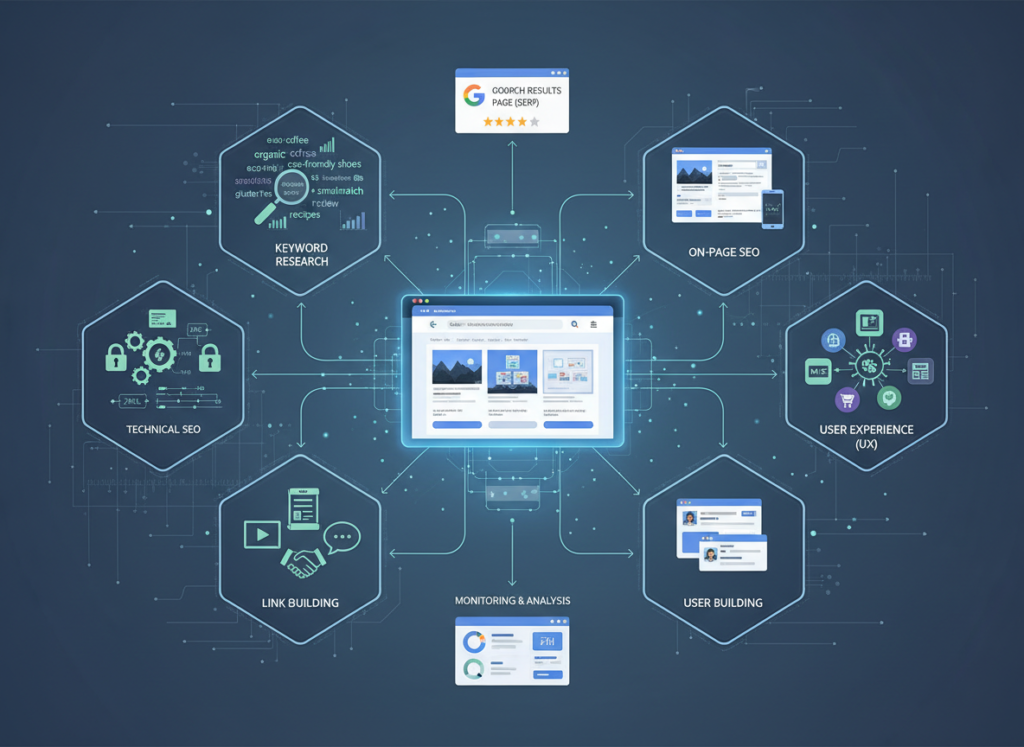
Ecommerce SEO is not a single task; it is a multi-layered strategy involving technical optimization, content creation, and authority building.
There is a clear process to follow:
1. Building a Professional and Technically Sound Website for Ecommerce SEO
You need to create a professional website, ideally using platforms like Shopify or a PHP-based solution (or other robust CMS like Magento or WooCommerce). The platform choice is less important than ensuring it provides the necessary technical control.
Elaboration: A professional website must prioritize site architecture and user experience (UX).
- Technical SEO Foundation: This is non-negotiable for successful Ecommerce SEO. It involves optimizing:
- Site Speed: Compressing images, leveraging browser caching, and minimizing code to ensure pages load quickly.
- Mobile-First Indexing: Ensuring the site is fully responsive and offers an excellent experience on all screen sizes.
2. The Advanced Keyword Research Process for Ecommerce SEO
The direct process for this is to go to Google Keyword Planner, extract your seed keywords (broad terms), and find relevant questions people are asking around those keywords on marketplaces, competitor websites, and review sites. You will then answer these questions on your blogs, category pages, and product pages.
E-commerce SEO keyword research focuses heavily on user intent. We categorize keywords by where they fall in the buyer journey:
- Informational Keywords: Target your blog content to attract new visitors.
- Commercial Investigation Keywords: Target category and comparison pages.
- Transactional Keywords: These are crucial for product pages.
Tools like Ahrefs or Semrush allow you to uncover the exact long-tail phrases that indicate strong purchase intent. Furthermore, analyzing the People Also Ask (PAA) section on Google helps you understand the specific language and needs of your target audience.
3. Optimizing Your Category Pages for Ecommerce SEO Performance
You can rank your website by using clear breadcrumbs and rich, comprehensive content. Put that content in the footer of the category page. Also create keyword optimized meta title, meta description, and title (H1) for that category page.
Category pages are the workhorses of an e-commerce store.
- Breadcrumbs: These navigational aids reinforce the site structure for search engines via internal linking. (See Tip 1 below for more on internal links).
- Content Strategy: A well-written, keyword-optimized content block (200-500 words) placed at the bottom of the page can target both the main keyword and related long-tail keywords.
- Metadata Optimization: The H1 Tag should be the primary category name. The Meta Title and Meta Description must be unique and compelling, including the primary keyword to maximize the CTR from the SERPs.
4. Optimizing Your Product Pages for Conversion
Create FAQs, keyword optimized product descriptions, Product Title (H1), Meta title, and meta descriptions.
Elaboration: Product pages are where transactions occur, so optimization must focus on conversion.
- Unique Product Descriptions: Write unique, detailed descriptions (300+ words) that highlight features and benefits.
- Product Schema Markup: Implementing Product Structured Data is vital for successful E-commerce SEO. It allows Google to display Rich Snippets showing the price, availability, and average customer rating.
- Image Optimization: Every product image must be high-quality and fast-loading. Crucially, use descriptive ALT text for all images (e.g.,
alt="High-quality image of a product optimized with **e-commerce SEO**") which aids accessibility and image search ranking.
5. Building Authority through Backlink Profile Analysis
Check your competitor backlink profile and create backlinks on those websites from which your competitor is getting link juice. This is crucial for strengthening your overall E-commerce SEO strategy.
Elaboration: Link building (Off-Page SEO) is about acquiring links (votes of confidence) from other reputable websites.
- Competitor Analysis: Tools like Ahrefs are used to audit your top-ranking competitors’ profiles to identify high-quality, relevant domains.
- Outbound Links: When creating new content, strategically include relevant outbound links (e.g., to a reputable industry report or a related vendor site) to enhance the trust and authority of your page. For example, [reference a current study on online shopping behavior].
- Link Acquisition Strategies: Focus on links that are high in Domain Authority (DA) and highly relevant to your niche, perhaps through expert interviews or resource curation.
What are some common Ecommerce SEO tools?
Ecommerce SEO tools like Ahrefs backlink checker, Google keyword planner, SEOquake, and UberSuggest are the tools that we can use to make our website SEO optimized.
Elaboration: While the list above is a great starting point, a comprehensive toolkit also includes:
- Google Search Console (GSC): Absolutely essential for any E-commerce SEO professional. It reports on your website’s indexing status, crawl errors, and technical health.
- Semrush: A direct competitor to Ahrefs, providing powerful features for site auditing, content analysis, and competitor keyword research.
- Screaming Frog SEO Spider: Used to crawl your entire website and quickly identify technical SEO issues like missing meta descriptions and improper heading tag usage.
What are the best tips for a winning Ecommerce SEO strategy?
Just follow the process of doing E-commerce SEO for your website or store which is given above in this article: do proper keyword research, proper competitor backlink analysis, and create keyword optimized content on your website. Also, take care of the technical things as well, like page loading speed, create proper keyword optimized meta title and meta description, and put proper internal links and external links on your category page. That’s all, these are the only best tips that you can use for your E-commerce SEO strategy.
The core strategy is consistency and attention to detail:
- Prioritize Internal Linking (Internal links): This is often overlooked but extremely powerful. Link from high-authority pages (like the homepage or popular blog posts) to your core category and product pages using keyword-rich anchor text. This passes “link juice” internally and reinforces the topic relevance of your money pages. For instance, link from [Your Blog Post on Latest Trends] to the relevant internal link category page.
- Monitor and Reduce Faceted Navigation Issues: Without proper handling (using canonical tags), filter variations can create thousands of duplicate pages, harming your overall E-commerce SEO.
- Manage Out-of-Stock Products: If the product is discontinued, redirect it (301 redirect) to the most relevant category page.
- Content Pruning: Regularly review content that is not generating traffic and either update it or remove it to focus Google’s attention on your highest-performing pages.
Why is E-commerce SEO important for online businesses?
E-commerce SEO is important for online businesses to get more revenue and increase the ROI without spending money on ads. This is a great long-term strategy for any e-commerce business growth.
E-commerce SEO is fundamentally a cost-effective, long-term acquisition strategy that builds a durable asset.
- Lower Customer Acquisition Cost (CAC): Over time, the cost per customer acquired via organic search drops significantly, boosting profitability.
- Superior Trust and Credibility: Ranking organically on the first page instills far more trust in a consumer than a paid advertisement.
- 24/7 Visibility: E-commerce SEO provides passive visibility. Your store is promoted 24 hours a day, 7 days a week, reaching customers precisely when they are searching for the products you sell.
- Market Share Dominance: By optimizing for hundreds of long-tail keywords, a successful E-commerce SEO strategy allows a business to capture small pieces of traffic across a vast range of search terms.
You can also contact using linkedin or visit contact us now.
Leave a Reply